DRM for associations: protecting standards, publications and member content
An association's documents are unusual: they are simultaneously the product members pay for, the non-dues revenue line, and the public face of the profession. A standard that circulates freely stops being a member benefit. A conference proceedings PDF forwarded to a whole department is revenue that never arrives. And unlike a software subscription, a document — once sent as a file — never expires on its own.
This guide covers the three content problems specific to associations and standards bodies, and how policy-based protection addresses each.
Problem 1: membership benefits that outlive membership
Member-only publications are usually delivered as downloads. When membership lapses, the downloads don't. Over years, the gap between "current members" and "people with the member library on their laptop" widens — and with it, the question every renewal committee dreads: why pay dues for what I already have?
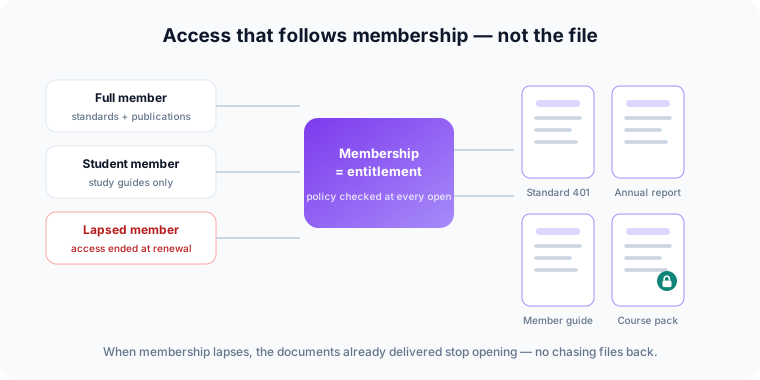
Protection inverts this. Access to each document is an entitlement checked at every open. Renewal continues access; a lapse ends it — including for documents delivered years ago. The member library becomes a living benefit rather than a one-time transfer.
Problem 2: standards that leak by institution
Standards and guidelines are bought once and used by many — that's their nature. The failure mode is when one purchased copy becomes an entire industry's copy. Reader-identifying watermarks change the economics: every protected view names its authorized reader, so an uploaded standard traces to a purchaser instead of arriving anonymously. Combined with device limits, a single license stops silently serving an unlimited audience, while the legitimate purchaser's experience stays simple: open a link, read in the browser, nothing to install.
Problem 3: tiered access without tiered chaos
Full members, student members, chapter leaders, non-member purchasers — each sees a different slice of the library, for a different period. Managing that with folders and email attachments doesn't scale. With policy-based protection, the tier defines the policy: which documents, which expiry, printing allowed or not, how many devices. Change the policy and it applies at the next open, without re-sending anything to anyone.
Connecting membership data
The entitlement source of truth is your membership system. MyPass DRM exposes the same operations the workspace uses — protect a document, grant a reader access, revoke it, read access events — through a public REST API, so membership changes in your AMS or member database can drive document access automatically: join grants, lapse revokes, renewal restores. For associations running education programs, MyPass DRM is also the native protection layer for MyPass LMS. See solutions for associations & standards bodies.
What to expect honestly
Protection will not stop a determined bad actor from photographing pages, and any vendor promising total prevention is overclaiming. What it changes is the default: sharing stops being effortless and anonymous, lapsed access actually lapses, and when content does surface where it shouldn't, you know whose copy it was and can end that access in one action. For most associations, that shift — from unmanageable files to identifiable, revocable access — is the entire point. The security overview details the limits.