Protecting certification exam content and courseware from leaks
For a certification body or training provider, content is not marketing collateral — it is the product and the credential's integrity in one. When exam preparation guides circulate freely, when courseware gets resold, or when actual item content surfaces on a forum, the damage compounds: development cost is sunk, the credential's value erodes, and honest candidates subsidize the ones who didn't pay.
This guide covers how leaks actually happen and which controls map to each path — with honest notes on what protection can and cannot achieve.
How training and exam content actually leaks
- Casual forwarding. A candidate emails the study guide to a colleague. No malice — the file was just a file, and files get shared.
- Account sharing. One enrollment, several people. Common wherever content is priced per learner.
- Post-enrollment persistence. Access was supposed to end with the course; the downloaded PDF didn't get the memo. Last year's cohort quietly supplies this year's.
- Organized redistribution. Courseware resold on marketplaces, or exam-preparation content aggregated into "dump" sites. Rare relative to casual sharing, but the most expensive when it happens.
Mapping controls to each path
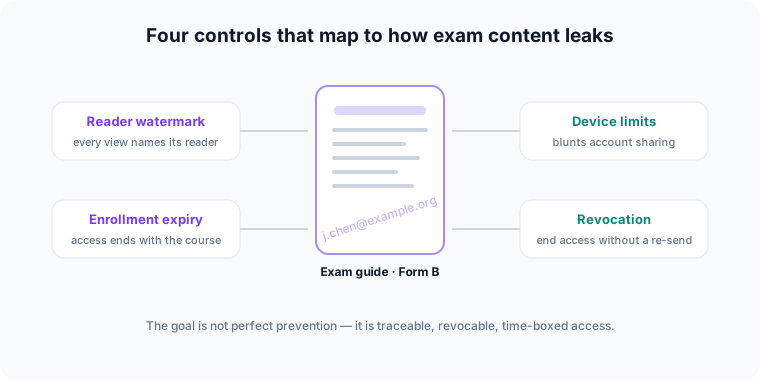
Reader watermarking — answers casual forwarding and organized resale
Every protected view carries the authorized reader's identity. That changes the forwarding calculus for a candidate — the copy names them — and when content does surface publicly, the watermark connects it to an account instead of leaving you with an anonymous PDF. Deterrence plus traceability is the realistic pair; anonymous prevention is not on offer from anyone.
Expiration tied to enrollment — answers post-course persistence
Set access to end with the course window or certification cycle. Because the policy is evaluated at every open, materials delivered on day one stop opening on the end date — no chasing downloads, no re-issuing files.
Device limits — answers account sharing
A learner authorizes a fixed number of devices. One shared login stops serving a study group, without punishing the legitimate learner who reads on a laptop and a tablet.
Revocation and access records — answers the incident you didn't predict
When something looks wrong — a refund, a violation, a compromised account — end that reader's access immediately, for content already delivered. The access record shows who opened what, when, and on which device, which is also what you want in hand for an integrity investigation.
Where the LMS fits
Protection works best when it follows enrollment automatically: enroll grants access, completion or expiry ends it, refund revokes it. MyPass DRM is the native DRM layer for MyPass LMS, so that lifecycle is built in — and for other systems, the same grant/revoke/audit operations are available through the REST API, so your existing LMS or commerce flow can drive protection. See solutions for training & certification providers for the fuller picture.
An honest note on exam security
Document protection secures distributed materials — guides, courseware, item banks in transit to authorized reviewers. It is one layer of a certification-integrity program, not a replacement for secure exam delivery and proctoring where the live assessment itself is at stake. We'd rather you scope it correctly than oversell it to your board. The security overview states plainly what MyPass DRM does and does not control.