Vitrium alternatives: choosing document DRM for publishers, training and member content
Vitrium has served the content-protection market for years, with a footprint among publishers, training providers, and associations — largely the same organizations that evaluate MyPass DRM. If you're researching alternatives, you're probably not questioning whether protection works; you're weighing how it's delivered, what an integration costs in practice, and whether the pricing unit matches how your content business actually grows.
As with our Locklizard comparison, we won't publish a feature-by-feature grid of a competitor's product — those go stale and mislead in both directions. Instead, this guide gives you the seven questions that actually decide these evaluations, and an honest account of where MyPass DRM fits and where it doesn't. Verify everything, including our claims, with your own content.
Why the same buyers evaluate both
Vitrium and MyPass DRM aim at overlapping problems: publications and courseware that generate revenue, member content that must track membership, and documents whose access should end when an entitlement does. Where evaluations diverge is usually on three axes:
- Delivery experience. How a protected document reaches its reader — a vendor portal, links under your own flow, or embedded inside your platform — shapes support burden and reader completion more than any single feature.
- Integration depth. Some platforms treat the API as an add-on to a console workflow; others treat the console as one client of the API. If your LMS, AMS, or storefront must drive protection automatically, this difference is the evaluation.
- Pricing unit. Content-protection platforms price on different units — users, documents, storage, or bundles. The right unit is the one that grows slower than your revenue does.
The seven questions that decide it
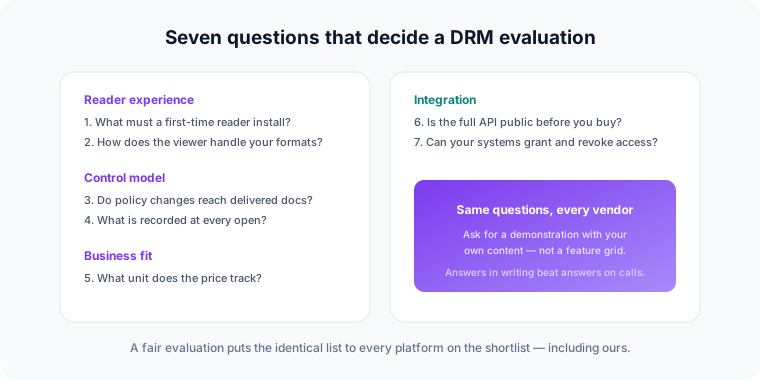
- What must a first-time reader do before page one? Count the steps yourself: clicks, installs, account creation, verification emails. Every step is reader drop-off you'll own.
- How does the viewer render your real content? Test with your heaviest document — the 400-page standard, the image-dense courseware — on a phone, not the vendor's sample PDF on a demo laptop.
- Do policy changes reach documents already delivered? Shorten an expiry, revoke a reader, and confirm a copy sent last week obeys. If protection is fixed at encryption time, "revocation" is marketing.
- What is recorded at each open, and can you export it? Opens, denials, devices — and whether that record leaves the vendor's dashboard when you need it for an audit or an integrity investigation.
- What unit does the price track? If you're growing readers on a stable library, document-based pricing favors you; if you publish constantly to a fixed audience, the reverse. Run your actual numbers two years out.
- Is the full API documented publicly, before you buy? A reference you can only see under NDA or after a sales call is integration risk being hidden from you.
- Can your systems grant and revoke access without a human? Membership lapses, refunds, enrollment endings — if these require someone clicking in a console, the protection model won't survive contact with your operations.
Where MyPass DRM fits — and where it may not
MyPass DRM's answers, stated plainly so you can hold us to them: readers open protected documents in the browser with nothing to install (see supported formats); policies are evaluated at every open, so changes and revocations reach documents already delivered; access events are recorded and exportable; the REST API is publicly documented down to each endpoint before you ever talk to us; and pricing tracks monthly active documents, not reader counts — which favors organizations with many readers per document, like associations and training providers.
Where we may not fit: if your evaluation centers on formats beyond documents-and-video, or on a fully vendor-managed content portal rather than protection under your own flow, test that requirement explicitly with us and with every alternative before assuming anyone covers it. Our security overview also states what no DRM can do — screen photography included — because a vendor who overclaims on that point will overclaim elsewhere.
A note on fairness: Vitrium's current capabilities are best confirmed on their site and in a live demonstration. This guide describes evaluation method, not their feature set — and the method applies equally to us.
What each platform publishes for pricing
Vitrium publishes its starting figures, which makes this comparison unusually easy: Vitrium Security Pro starts from $5,000 a year billed annually, and VitriumOne from $9,000 a year, with Enterprise quoted on request. Video and audio protection are a paid add-on to both, and SSO and third-party integrations sit in the Enterprise tier. Those are real annual-contract numbers for a platform built around scoped deployments.
MyPass DRM sits at the other end of the same market: free to 100 monthly active documents, then $39 a month or $299 a year to 500, with pricing tracking documents opened rather than seats or storage. If your evaluation includes both of us, the pricing unit is likely to decide it before any feature does — ours favours many publishers and bursty volume, an annual contract favours a large permanently active library with integration and procurement requirements.
The full published comparison, including the vendors that publish nothing at all, is on one dated page: what document DRM actually costs. Figures there were read from each vendor's own pricing page on 3 September 2026.